Any inquiry into a particular morphology of nihilism is certainly doomed from the start, for if there is no meaning in anything, how should there ever be one in such tried semantic excursions? Should one not abstain to venture into such murky waters, for the result cannot ever be anything other than pathetic? Perhaps so, yet maybe it is precisely because of such limitations that the nihilist ought to see past them; Nietzsche’s Übermensch not a caricature of what Nazism made it out to be but instead the prospect of the nihilist that goes further than anybody, the wanderer that reaches the cliff and jumps off in order to really make sure that even nothingness means nothingness. Yet, this inquisition into the sonic realms of nihilism – or the hues of nihilism vestiged as the sonic – is decidedly not a pessimistic one, not one stripped of the anthropomorphic framework, but one where the edifice of the human is intact but plagued by the principle of sufficient reason: if everything that exists ought to have a reason for existing, than even nihilism – the negation of meaning – has, if not meaning, at least a reason for existing (presumably to offer a counterpart to the sanctitude of being served up by decades of theology). Not quite a pessimist, the sonic architect of gloom thus asks, in a sempiternal ouroboros of incertitude: if everything is without meaning (nihilism), how can I make this meaninglessness mean something (Übermensch); can my questioning of the meaningless offer meaning in itself, as if to excavate the principle of sufficient reason underlying doubt itself without turning derisory of the whole entire human condition?
An evident entry point into the mind of the master builder of hopelessness would be to consider sonic traditions that reside in the dark alley of the tenebrous mind, especially those belonging to the traditions of black metal, noise and industrial music in general. Black metal is tenebrous right from the start, its colonography deferring to that which reflects no light and swallows all else; that from which there is no escape. In fact, the nihilist, consumed by meaninglessness, will find it incredibly difficult to relate to many of what the non-nihilist deems as important; the consequence of nihil-pilled: once in, there is no going back because every other constellation of ideas seems, defacto, pointless (if anything and everything is meaningless, this should come as no surprise). Yet, the unfortunate history of black metal goes even a step further: not only is existence meaningless, the worshipping of an entity that might safe life from being meaningless is taken as a personal attack, as if one has to rectify the rift from themselves and God into an even bigger rift. Theology is here attacked simply because it tries to find answers to that which the nihilist – in black metal often synonymous with the “satanist” – has already done away with. It should be noted that, although the rather tainted reputation of black metal precedes it in many regards, not every black metal musician inherently has an interest in burning down churches or decapitating animals in order to use their remains as stage-props (Gorgoroth). Yet, black metal’s nihilism manifests itself in an opposition of anything that might even offer a slither of light shining or passing through. The very same aversion towards the “light” – as hope – can be found in noise and its many subgenres, with a perhaps intensified pessimism underlying the hopelessness: songs are, often, stripped from the vocal element, leaving the evocation of semantic meaninglessness to instruments or objects that ought to suggest or imply nihilism but never spell it out entirely (for that would be pointless, right?). So, noise’s nihil resides in the abrasiveness of the sound itself, in the way in which dissonance and often very high frequencies (that are omitted in casual pop-centric compositions) convey a sense of sonic oppression. Combined with the often loud volume of noise-based concerts, this kind of sonic nihilism is one that doesn’t even believe in itself: many artists of the genre are not able to make a living from music, it often being something between a side-hustle and a sonic abduction, and actively refuse mainstream channels of distribution. Beyond the personal decisions of the artists, the genre itself doesn’t even lend itself to popularity: many compositions from the likes of Vomir, Black Leather Jesus, Ramleh and others aren’t made for appeal, with the abrasive distortion inherent in many works by such artists being driven to such extremes that even faith in a given PA-system now seems meaningless. There are, in fact, many stories of Japanese noise-grand-master Merzbow blowing out monitors at concerts, for example. Noise, as a genre, is the apotheosis of the nihil, with nothing representing the spirit of dissolution better than a slogan found on the back of a limited T-Shirt run from noise-based label Industrial Coast: “All noise labels die broke”. Noise doesn’t even believe in itself, all the while still existing in the shadows.
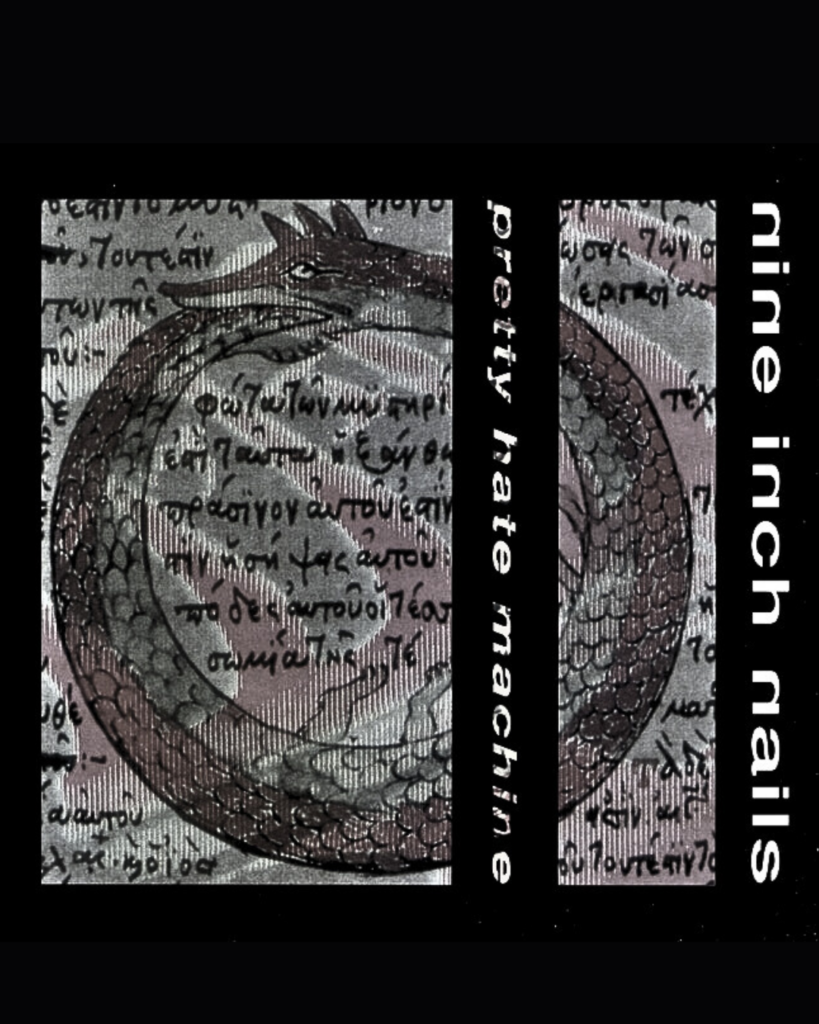
A perhaps more lyric-centric approach to nihilism can be observed in the work of Nine Inch Nails, with particular attention to the lyrical content of Trent Reznor’s writing. From the very first album, the band made it clear that what they were doing was nowhere near to a happy-go-lucky approach. If the title of the first album, “Pretty Hate Machine” (1989), might still offer some kind of embellishment of the underlying current of the black waters of disdain running through the lyricism, the following album and its title would cement Reznor as one of the most consequential nihilists in the contemporary musical landscape. “The Downward Spiral” (1994) offers no absolution, not hope for things getting better and certainly to moment of looking up to check for light; this is a hagiography of Saint Nihil, with the spiral being significant because, as long as one keeps spiraling, it could, technically, go one forever. More than just the content of each album and song title, the band’s sound itself is particularly attuned to a kind of instrumental meaninglessness, with the only possible conclusion being the overriding of the system itself; if the edifice is itself depressing, turn everything up to eleven and disrupt the CPU power of your console. No other track represents this dichotomy better than “The Background World”, with the instrumental extended into self-oblivion, perhaps a subtle nod to William Basinski’s magnum-opus “The Disintegration Loops”, almost as if even the belief in one’s own instrument has found itself dwindling. Sure, most of the band’s catalogue still belongs to a kind of dance-centric musical tropes, evident in Reznor’s biggest musical inspirations being people like David Bowie and Prince. Yet, if Prince made the saints get up from their chairs, Reznor seems more interested in an insurrection of the un-dead, of those that, despite life’s meaninglessness, find enough strength in their disdain for mundanity to actively hate it. “God is dead, and no one cares / If there is a hell, I’ll see you there” sings Reznor on 1994’s “Heresy”, both as a nod to the patron saint of nihilism (Nietzsche) as well as to restate the obvious: I don’t even fully believe in hell, perhaps not even in the afterlife itself, but if there should be a hell, that is the only place that will host me in the end. Here, black metal’s insistent disdain for theology and religion is turned on its head: the absence of God doesn’t even require action anymore, not even a hint of externalized aggression because not only would that also be pointless, but nobody cares enough about the absence of God in the first place, thus eliminating even every wish for revolt.
“Right Where It Belongs” offers a more poetic although even less hopeful sonic environment: “What if everything around you isn’t quite as it seems? / What if all the world you think you know is an elaborate dream? / And if you look at your reflection / Is it all you want it to be? / What if you could look right through the cracks? / Would you find yourself / Find yourself afraid to see?”. There is quite a lot to unpack here. Firstly, this is not an elegy for nihilism; this is the nihilist warning those who have not yet succumbed to hopelessness. Yet, in their warning, the nihilist here offers also a kind of truth-serum, a kind of “actually” disguised as a “what if”, a show instead of telling. The nihilist here becomes the cartographer of dreams, he who can shift between states of wakefulness, thus presenting the nihilist not as the hopeless but as the illuminated one, the one that, now knowing that there is no meaning in anything, strangely knows more than the others that still strive its rescue. This sudden illumination is not one without its own fair share of problems; “(Would you) find yourself afraid to see?”. Here we return to the conundrum of the nihilist, for even knowledge of the absence of reason is a burden in itself. Sure, one must entertain the idea beyond the principle of sufficient reason in so far as to come to the conclusion that there might actually not be any reason or any of this – gesturing at the world at large – existing. Yet, this realization is a double-edged sword: it offers illumination but also, simultaneously, augments tenebrosity. Reznor then turns the nihilism inwards, transfiguring it into self-reflection: “And if you look at your reflection / Is it all you want it to be?”; here Reznor inadvertently ventures into Thomas Metzinger’s concept of the phenomenal self-model; i.e a model of the self built on the transparency of the inner network making up the model as a whole, with the organism unable to see into the infrastructure that actually makes it up. Because it’s representational detectors work “too well”, because we rely so heavily on them, the self is brought into being because we cannot even question the representational metrics that constitute it. Yet, as Metzinger argues, the self ought to therefore be an illusion because one cannot introspectively access its components. Reznor projects the self onto a reflection of the self, thus implying that only in representation, one can be sure that “yes, this is me”, giving the impression of a first-person-experience. It is not even I who needs forming, but my reflection that determines my essence, as if only in the moment one is confronted with the evidence of a seemingly first-person experiential perspective one can be held liable for living. Yet, is this evidence of life “all you want it to be?”; Reznor here doesn’t even believe in self-realization, as if absolution from what one is or what one lacks is relegated to the splitting of the self into reflection and it’s humanly shell.
The song “Capital G” offers another moment of lyrical disillusion: “Well, I used to stand for something / But forgot what that could be”. In the actual song, Reznor alludes to a kind of jaded authority figures that laments the loss of their idealistic rebel-self, but nihilism offers another reading of the passage above, one where the loss of belief doesn’t necessarily simulate the search for different, new kind of one. Here, our protagonist of the nihil finds themselves suddenly wayward, in a state of what Georges Bataille might refer to as “discontinuity” not with the world, but with their own sense of belief. This belief can certainly be interpreted as a theological or idealistic one, but perhaps a reading more concerned with an ontological perspective might offer a deeper understanding of Nine Inch Nail’s sonic nihilism. For, if nihilism already presupposed the human outside of the world – in the most extreme case, that, in itself, can never be realized and only imagined – of belief, how would one ever be enticed to belief in one’s own ontology, now having “forgotten what one stands for”, what one is. Even for the most arduous nihilist, there are traces of what one was before nihilism, of an acceptance of the modern human condition as striving for realization and thus, according to theologies near to Buddhism, only ever amounting to suffering, but the nihilist, disillusioned by the libidinal, by the search for a deeper meaning, cannot access this condition anymore. Their temporal and experiential reality is one of accumulation through negation: the more one deems meaningless, i.e the less one feels one ought to know, the greater a nihilist, which, for the nihilist, is often the only interest (to despise the condition of hopefulness even more, so much as to end up at a point where one might even feel disdain for the disdain one feel towards hope itself). Yet, as Reznor’s and the band’s career continue and life prolonged its course – something that a deeply depressive Reznor of “The Downward Spiral” might not even have deemed possible at the time – the material grew with it. This is not to say that the underlying nihilism began to dissipate into shore of sunshine and rainbows, quite the contrary: we find our nihilist protagonist at an impasse: if life itself is nihil (nothing), it is only so because life is a process and not just one thing or another. If then life is a process of nothingness, this nothing is not qualitative bur comparatively quantitative, with “Year Zero” being the moment in which all of nothingness comes to fruition; the nihilist as that for which everything has been negated and thus nothing else can be negated. The nihilist does not kill themselves, because they know even self-erasure would be pointless. Instead, they wait, doing nothing in a life of nothingness. “Yesterday I found out the world was ending” sings Reznor on “While I’m Still Here”, implying that today, when our nihil-protagonist is writing, the world has not yet ended. We do not know if they relish in this understanding of if despair is around the corner. The following lines of the same song provide more clarity: “A litte more / Every day / Falls apart and / Slips away / I don’t mind / I’m okay / Wish it didn’t have to end this way”. The nihilist is unmasked: atop of their architecture of disdain, they still would wish for there to be another way to view man’s ontology, to have something more hopeful to say. They say the are ”okay” and that they “don’t mind”, as if expecting it to go this way all along, hope for mankind defenestrated and all, but are they? Are they really okay in their own nihil even if they wished for things to end a different way? In the face of ultimate fatalism, of irreconcilable catastrophe, the nihilist finds themselves looking for a way out of their own nihilism, as if begging for something to be more powerful than the grip of eternal nothingness. They would never say this out loud, no; only the end of the world could ever bring out hope from the nihilist. Yet, now the world is ending and it’s too late even for hope: the ultimate realization of our sonic nihilist.
In many ways, the sonic artifice of gloom ought not to bound to the instrument as their weapon of choice against the entire universe. In fact, the sonic can also be suggested through sheer language alone. Even if one merely glances at the work of Emil Cioran, for example, one will soon sense of compelling feeling o rhythm cascading from his invocations against human kind, and this with no instrumental accompaniment. The hopeful nihilist (which is an oxymoron but let us entertain it for storytelling purposes) could almost venture into saying that what Cioran does with words he does so captivatingly that he doesn’t even need an ensemble; the author as its own full choir of depression. “We live in order to unlearn ecstasy”, “All of us are miserable, but how many know it?” and “Let desire be stricken from the dictionary, and from the soul! I retreat before the dizzying farce of tomorrows. And if I still cling to a few hopes, I have lost forever the faculty of hoping” are but a few highlight from “A Short History Of Decay” and perfect examples of Cioran’s melody, as if life was but a compositions to which the author only ever had to discover the key it was played in (and yet, in perfect nihilist fashion, even that eludes him). Sure, Cioran might be better classified as a pessimist, but the lyrical tone of his aphorisms still retain a particular sense of musicality; in fact, one could even suggest the proximity to poetic prose of the aphorism style in itself, lending itself far better to musical accompaniment than, say a one thousand page novel. A similar effect can be observed in the writings of Fernando Pessoa and Clarice Lispector, or, for that matter, in any other author whose predilection for the aphorism supersedes the wish to craft a more cohesive novel. They don’t, precisely because they know they will fail, their efforts not amounting to anything that nihilism cannot take down.