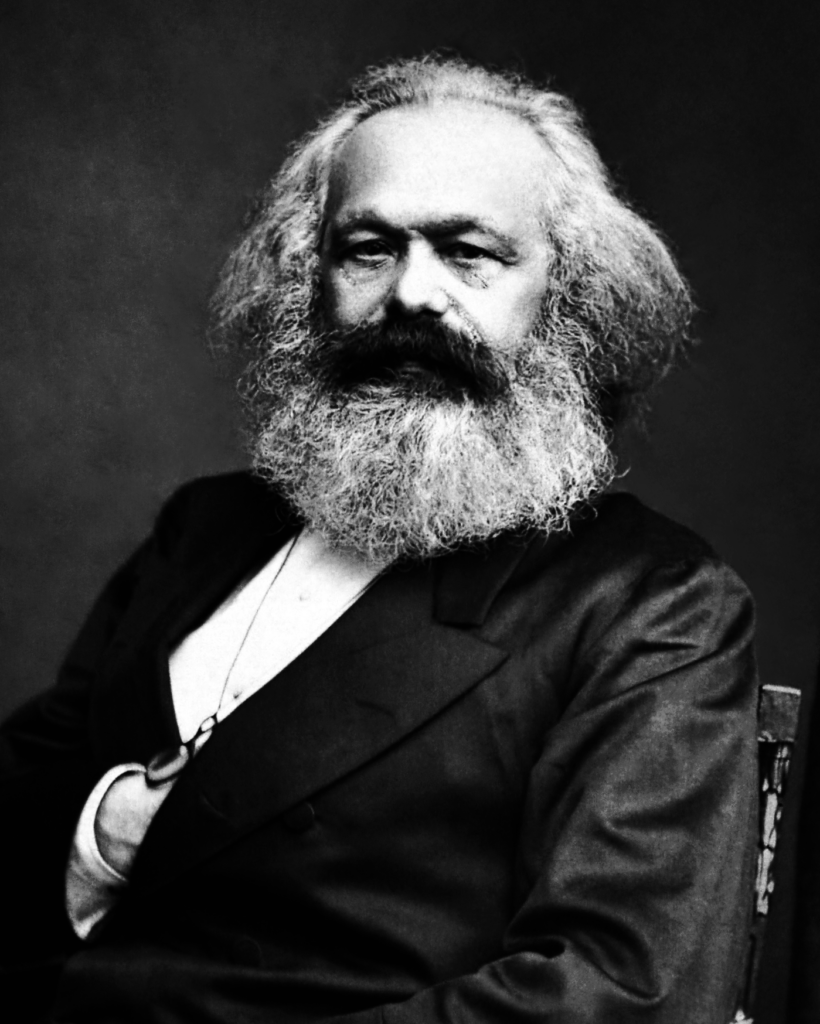
The dark arts have long been an area off limits, to the rationally minded, well regulated psyche. In the life of Marx, rationality was abandoned by him, as early as his teenage years, when he began to obsess over the famous line from Goethe’s Faust : „All things must perish.“ Not only did Marx quote this devilish line, from the mouth of Mephistopheles, he soon began to develop an unhealthy pathological aversion to the whole notion of social class distinctions, and the institutions of 19th Century politics. Not unlike Lucifer, in the Bible, Marx was resentment-filled, and desired to do away with the established authority, which led to his own downfall. In a Jungian archetypal sense, Marx was unable to properly integrate his shadow self, and this could only mean he would choose to manifest evil—the perennial path to wickedness comes from the rejection of the light, of the good, and a hatred of God.
Marx did not stop at simply rejecting God, and despising the conventional social class hierarchization, Marx went so far as to put on a play, whose main character was a devout worshiper of Satan. It is no joke, you know, that Marx felt that he was emulating Goethe, the archetypal German literary mastermind, as he saw it necessary to vicariously follow in the path of the Father, in order to make a name for himself. An analogous example in the animal kingdom, can be seen, in chimpanzee male dominance hierarchies, where up and coming male chimps seek to emulate the strongest elder male chimpanzees, as a sure way to success. Thus, similarly, Marx thought it optimally advantageous, to repeat the themes of Goethe’s famous work.
In select letters, addressed to his friends and family members, Marx even refers to himself as a „little devil,“ „your devil,“ and „a demon.“ Such self-estimations are not merely figurative, they are in fact, conscious unsanctioned, falsely integrated, and dangerous pathological, mnemonic devices, which result in the possibility for violent tendencies. This is why Marx was so evil, because he thought of himself as equal, nay, even the incarnation of Mephistopheles. I am not one to rely on conjectural premises—it is one of my 12 rules, not to commit such a fallacious methodological error—yet, in unprecedented cases, when we are trying to understand the grave effects of Marx, and the insane, resentful, genocidal, anti-patriarchal, atheistic, 20th Century catastrophes, we must be severe in our analyses.
Of course, what needs further elucidation in the “Marxian pathological problem” (as I have clinically diagnosed it) is the Demon Archetype. I once thought I could interpret the vile nature of Marx, with reference to the demonic figure of Ahriman (from the Zoroastrian religion.) However, upon direct confrontation with evil, in all my years as a practicing clinician, I found that the Zoroastrian embodiment of the Demon is actually less formidable than that of the Jewish Demonic manifestation—known as Asmodeus. I began diving into this Jewish myth, and its manifold history. I spent countless evenings meditating on the story of Asmodeus in order to be hyper-conscious of it. This allowed me to inhabit the myth—vicariously—in my waking life. Not even Jung could’ve endured such severity, immensity, and terror, in his experimentations with dream. If it’s true, in the various accounts of Asmodeus, he was so evil as to murder the husbands of countless women. This kind of devilish manifestation is a direct lineage to the kind of monstrosity that Marx became. An embodiment of the Jewish Demon.
Marx was not entirely proud of his Jewish heritage, and yet, he wanted to be a religious figure—which is where his arrogance lies. As a quasi-religious figure, he became a “false-prophet.” He led the so-called “oppressed classes” to their untimely fate. It was Nietzsche who predicted, along with Dostoevsky, that a maniacal man would bring about the deaths of millions, in the name of social prosperity, which they most certainly meant Communism, Marxism, and Socialism (even if Nietzsche and Dostoevsky forecasted these events, decades before they happened.) Even if Marx didn’t directly practice ritual sacrifice, with his satanic contemporaries, he in principle, precipitated the same malevolent form of degeneracy, and even generated harm, by way of his polemical writings (in the Communist Manifesto.) Marx is the progeny of a disastrous archetype, the likes of which we find in that poet Byron, the equally dark and pathological (maybe even psychotic) Rousseau, and the inhuman behaviors of Mao, Lenin, Stalin, and Pol Pot. The theory of Marx was the first instantiation of the communist mental disease, and it forcefully reared its ugly head, once it got into the hands of the most evil men, of the last century.